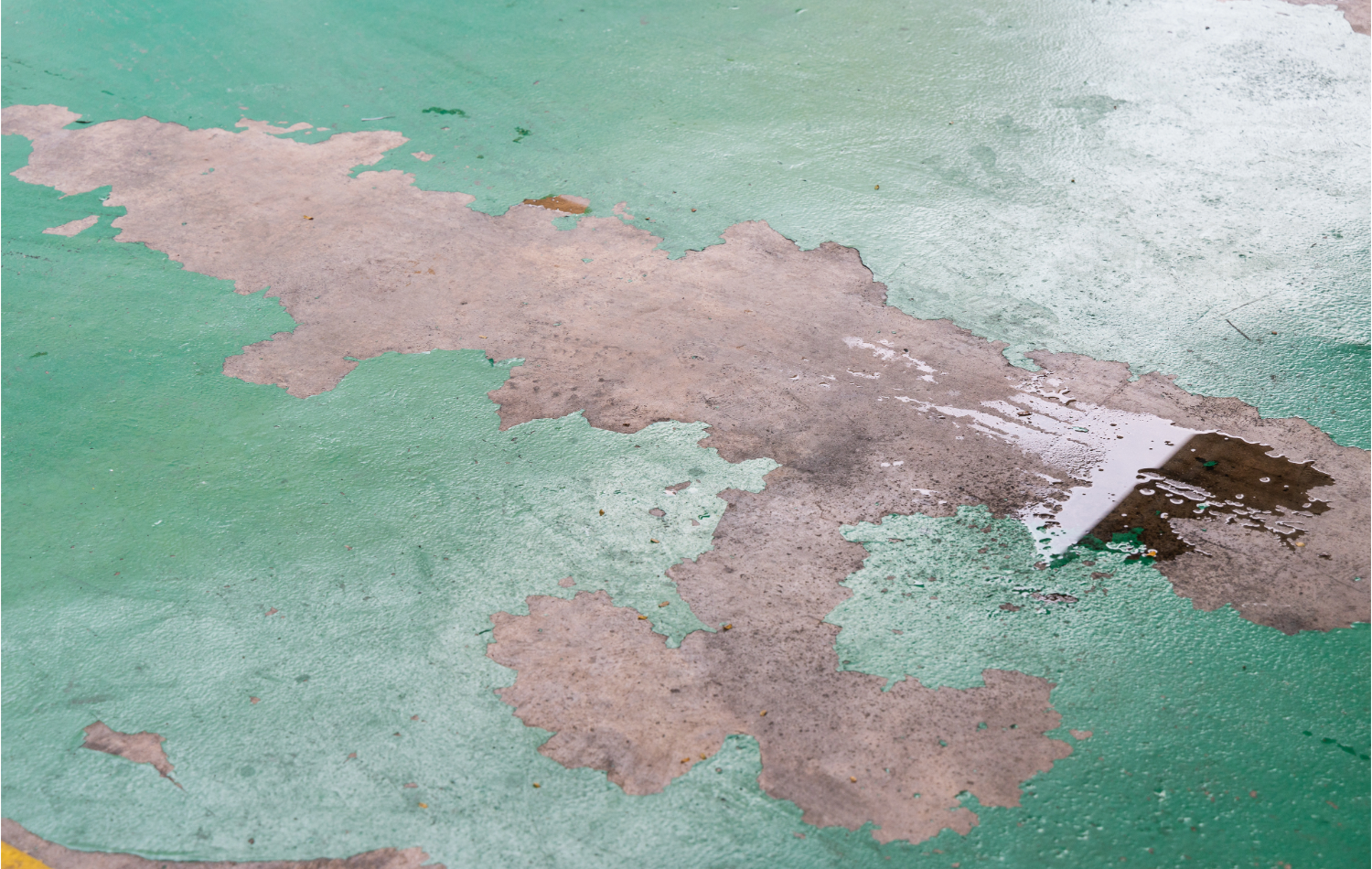

Many homeowners looking to upgrade their garage floor will come across DIY epoxy kits or “concrete paint” as we hear many customers call it. We want to help you make the right decision for your concrete before jumping into a project like this yourself. The store bought kits might be enticing because of their initial cost, but there is a reason for that. As the saying goes, “you get what you pay for!”
DIY Epoxy Options
There are a few different DIY options available at big box stores, but not all of them are created equal. Understanding the differences is key before deciding which route to take.
Garage Floor Paints
Many homeowners use “floor paint” and DIY epoxy kits interchangeably, however, they are technically different. You can buy a gallon of latex or acrylic paint that sits as a top layer on your concrete. This is not comparable to epoxy in any way, and will not hold up to the wear and tear your garage takes if you are driving on it, or working in it in any capacity.
Rust-Oleum makes a paint designed for garage floors, but many of the reviews show that the paint peels within weeks of driving on it. We have been in many homes that need to be re-coated professionally after just a few months after putting down a thin top-coat of paint.
Store Bought DIY Epoxy Kits
We also have homeowners that call the DIY kits you can buy from Lowes or Home Depot “paint”. However, for this article we will refer to these as “kits”. These differ from a gallon of paint in the sense that many of these kits are 2-part kits with a base layer and a top-coat, which is certainly better than a thin top-coat alone.
For $400, this option might seem like a steal compared to a professionally installed epoxy coating, but we want to walk you through the process of a professional floor coating, and explain why these kits are priced the way they are.
Downsides of DIY Epoxy Kits
While DIY kits may seem like a cost effective solution, they come with several major limitations that impact durability and lifespan.
Coating Thickness
Store bought kits are extremely thin compared to professional systems. Most DIY kits will only achieve a total thickness of about 5 to 8 mils across both coats combined.
A professionally installed epoxy system typically ranges from 14 to 20 mils for residential applications. That added thickness creates a stronger barrier against impact, chemicals, and wear.
Understanding Epoxy Coating Thickness Measurement: Mils
A “mil” is a unit of measurement equal to one thousandth of an inch. While that sounds small, it makes a huge difference in performance.
For example, a 5 mil coating is less than half the thickness of a professionally installed system. Thicker coatings provide better durability, improved resistance to hot tire pickup, and longer lifespan overall.
Think of the difference like comparing plastic wrap in your kitchen to a heavy-duty tarp.
Coating Hardness
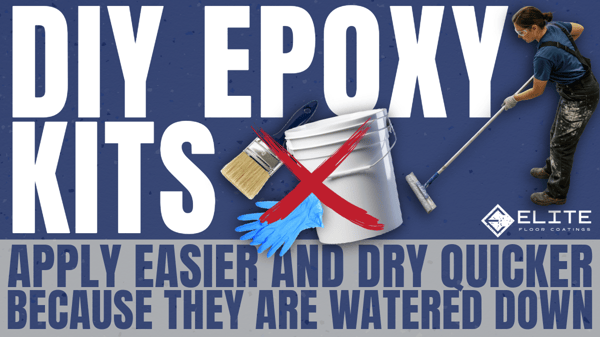
Most store bought epoxies are diluted to make them easier to apply for homeowners. This lowers their solids content, which directly impacts hardness and durability.
Professional grade epoxy systems are typically 90+ percent solids, meaning very little evaporates during curing. Many DIY kits fall closer to 30 percent solids, which results in a softer, weaker coating that is more prone to scratching, peeling, and tire marks.
This difference in solids content is one of the biggest reasons DIY coatings fail prematurely.
Limited Material
DIY kits are packaged to cover a specific square footage with very little margin for error. If your concrete absorbs more material than expected or if your application is not perfect, you can end up with thin or uneven coverage.
The same applies to decorative flakes. Most DIY kits include only 5 to 10 pounds of paint chips, which results in a light broadcast that offers minimal protection and visual appeal.
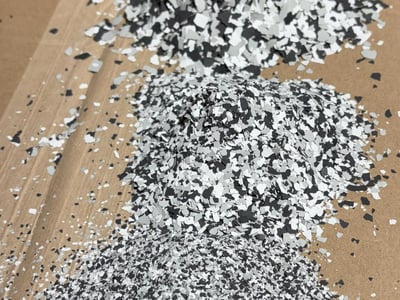
In comparison, we use up to 100 pounds of paint chips when installing a paint chip epoxy floor, creating a much thicker surface layer that not only looks better, but adds an ideal surface for the top coat to adhere to. This also aids in creating a thicker, harder top layer of polyaspartic.
Type of Material
Most store bought kits and paint will have a very thin polyurethane top coat that is put on top, but the issue with this finish is it is not UV-resistant, and the sun alone will eventually ruin the coating if the normal wear and tear doesn’t do it first.
We use a hybrid epoxy-polyaspartic system on our concrete because the polyaspartic top-coat is UV-resistant and extremely durable. This is one of the main factors that make our floors last for decades.
Lifespan
Most DIY epoxy floors we come across are damaged within the first few months, and need replaced entirely within the first two years. We have had homeowners tell us they damaged the floor they installed themselves by just dropping a tool from the toolbench.
In comparison, a professionally installed epoxy coating will last at least 20 years if not more. We have been installing epoxy coatings for 21 years, and the floors we coated in year one still look great and are fully functioning all these years later.
Importance of Concrete Prep
One of the most overlooked aspects of epoxy flooring installation by homeowners is the surface preparation. Even the best coating will fail if it is not applied to properly prepared concrete.
Most DIY kits recommend acid etching, which is not nearly as effective as mechanical grinding. Acid etching often fails to open the pores of the concrete evenly, leading to weak adhesion.
At Elite Floor Coatings, we use commercial grade diamond grinders to remove the top layer of concrete and create the ideal surface profile. We also use a shot blaster to fully clean and prepare the surface before applying any coatings. This process ensures the epoxy properly bonds to the concrete, and you won’t have peeling and chipping from car tires and or dropped tools.
Cost of Epoxy Kits vs Professionally Installed Floors
You can find garage floor paints as low as $40/gallon, and store bought epoxy kits as low as $200. The better 2-part kits will run you around $500, but will not come with any of the prep equipment, and as discussed above, a very limited amount of material.
A professionally-installed paint chip epoxy floor will run you between $6-$10/square foot. For a 450-square foot garage you would be looking at a $2,700-$4,500 investment.
You might be able to save some money upfront by trying the DIY approach, but if you have to redo your floors every two years then you will regret not having invested more upfront to have a coating that lasts the next 30 years.
Commercial Grade Epoxy Garage Floors by Elite Floor Coatings
We have been coating concrete for over 20 years, and have seen the worst of the worst when it comes to attempted DIY jobs or in some cases poorly installed “professional” jobs. We take pride in walking our customers through the process of coating their floors, and guiding them to the proper coating for their needs. If you are looking to upgrade your ugly concrete, give us a call!
.jpg)